
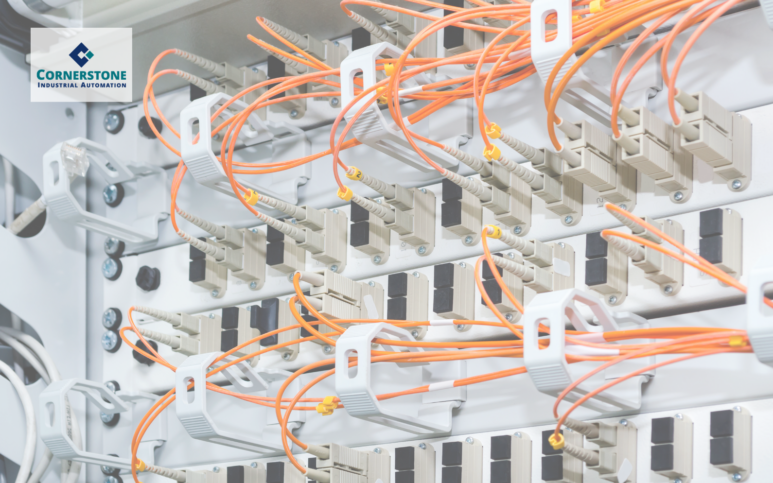
After intermittent heat-treating data loss began creating production risk, Cornerstone performed a plant-wide network audit and uncovered broader issues with reliability, redundancy, obsolescence, and maintainability. The resulting upgrade simplified the network architecture, improved resiliency, and gave the plant a more manageable foundation for future growth.
The more important an industrial network becomes to production, the harder it becomes to replace. At a Pennsylvania heat-treating facility, a 2025 audit by Cornerstone Automation found that intermittent data loss was connected to broader problems with the network infrastructure. Years of additions and changes had left the network increasingly complex. Rather than address the data-loss issue in isolation, Cornerstone and the customer used the audit to plan a broader upgrade.
When Lost Data Can Mean Lost Production
The records associated with a heat-treating cycle can be important to the material being processed. When the plant lost that data during collection, it had to notify its customer, who could accept the material as is, require the job to be rerun, or decide to scrap it. Rerunning a job could mean hours of lost production.
Cornerstone’s network audit identified several conditions that could affect communications reliability. Critical SCADA data traveled through multiple network devices before reaching the data collection server, and a firewall created another potential bottleneck. Some Ethernet runs exceeded recommended maximum lengths and were experiencing transmission errors and packet loss. Backbone connections relied on copper rather than fiber, increasing the potential for electrical interference and transmission issues, and portions of the network included multiple unmanaged switches connected in series.
Why a One-for-One Replacement Didn’t Make Sense
The existing network had grown into eight IDF locations, including areas with overlapping coverage. Roughly half the cabling was unlabeled, complicating troubleshooting and increasing the risk of production loss when issues occurred. Some commercial-grade switches were rated for ambient temperatures as low as 104°F but were installed in undersized enclosures where temperatures could exceed 130°F, and much of the equipment lacked redundant power. Physical access to network equipment was unrestricted in several locations, creating a security and infrastructure-management concern. Other hardware was obsolete or no longer receiving security updates or manufacturer support.
Cornerstone determined that the plant could be covered with far fewer IDFs. The final design used three, balancing shorter cable runs with a much simpler overall architecture. The customer also wanted to relocate its MDF from an existing server room that occupied valuable plant space, and an alternative location was better suited to the network infrastructure. Together, these changes made a one-for-one equipment replacement difficult and unnecessarily disruptive.
Building the New Network Before Taking Down the Old One
One of the biggest engineering challenges was determining how to transition an operating plant onto the new network without disrupting production.
Trying to rebuild the existing IDFs in place would have meant working around undersized enclosures, poorly documented cabling, environmental concerns, and equipment that was still needed to support production. Eliminating IDFs would also require rerouting existing connections while portions of the old network remained operational.
Cornerstone determined that building a new network alongside the existing infrastructure was the more practical and economical approach. The new network could be installed, configured, and commissioned before the old infrastructure was disturbed. Equipment could then be transferred between production runs without affecting production.
The only planned downtime for the entire project was one weekend day to relocate existing server equipment from the old MDF to the new location. For a plant-wide replacement involving new IDFs, a relocated MDF, new cabling, and a new network architecture, that limited outage required extensive preparation before cutover.
The network survey called for commissioning the new infrastructure first, establishing temporary links between the old and new networks, and moving field equipment one area or machine at a time as production allowed.
Using Redundancy Where It Matters
Cornerstone designed the new OT network infrastructure around a hybrid ring-and-star topology. The ring portion provided redundant network paths so that a single failure would have limited impact on production, allowing equipment not directly affected by the failure to continue operating.
For less critical equipment, simpler star connections linked devices to a central network point rather than through a redundant path. That added resiliency where it mattered without unnecessary equipment and cost. The new infrastructure also lets plant personnel monitor redundant connections and identify link failures before a second failure causes production downtime.
The design also addressed a key survey goal: providing two paths from each OT network node to the data collection server so that a single backbone failure would not interrupt collected data. The new infrastructure included industrial network enclosures and racks, UPS-backed equipment, new fiber backbone connections and copper field connectivity, configured switches, and updated network documentation.
Upgrading Infrastructure the Plant Already Depends On
Cornerstone handled the network engineering, equipment supply, configuration, commissioning, and startup, while electrical contractors completed the structured cabling and installation work. The work had to be carefully coordinated around production and the cutover plan.
As Nathan Ferrin, Chief Technology Officer, explained, “The hardest part was all the planning and preparation that went into the cutover. By building and commissioning the new network before touching the existing one, we could move equipment over between production runs. The only real downtime was one planned weekend day while we relocated the server equipment.”
Cornerstone was already familiar with the plant’s controls environment through work on several furnace systems, including PLC and HMI upgrades, safety controls, alarming, trending, VFD controls, and communications with existing heat-treating equipment. That experience helped the engineers understand the production systems depending on the network.
A Network Designed to Be Maintained, Not Just Installed
The finished project gave the plant a stable, redundant network designed around current production requirements and future expansion without a prolonged shutdown. The architecture was simplified, new infrastructure was documented, and the plant gained the ability to monitor redundant network connections for failures. Since the upgrade, no further network-related heat-treating data loss has been reported.
Since completion, the customer has added devices to the network. Those additions can be incorporated into an organized, documented architecture, giving future maintenance personnel a clearer understanding of how equipment is connected.
Network hardware will eventually age and require replacement. The difference is that the plant now has a framework for maintaining and expanding it without recreating the complexity that had built up over time.
The Larger Lesson: Treat the OT Network Like Plant Infrastructure
Industrial networks need the same lifecycle planning manufacturers apply to other plant controls. PLCs become obsolete, HMIs age, and drives eventually need to be replaced. As more systems depend on the network, that infrastructure deserves the same attention to supportability, maintainability, capacity, and long-term reliability.
For manufacturers, that means evaluating the network before intermittent problems become larger production problems. Useful questions include whether equipment is approaching obsolescence, whether years of additions have created unnecessary complexity, whether adequate redundancy is in place, and whether the network has enough capacity for future connected systems. Plants should also understand what a network failure would affect and whether documentation accurately reflects how the infrastructure is connected.
Dealing with an aging or difficult-to-support industrial network? Contact Cornerstone Automation to talk through what you’re seeing and whether an audit or upgrade makes sense.